
Why Do Newborns Smile in Their Sleep? The Science Behind Those First Smiles

Quick answer
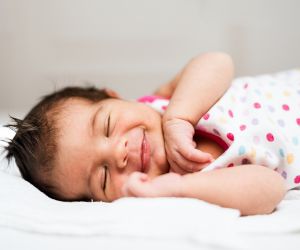
Few moments bring as much joy to new parents as seeing their newborn smile. Even more magical is catching a tiny smile while they're fast asleep. It's natural to wonder whether they're dreaming, recognizing a familiar face, or smiling because they're happy.
While these sleepy smiles are incredibly heartwarming, they're usually not the same as the intentional social smiles that develop later. During the newborn period, smiling while asleep is typically a normal neurological behavior associated with active sleep and the rapid development of the nervous system.
Understanding why newborns smile—and when those smiles become intentional—helps families appreciate one of the many remarkable stages of early infant development.
Key Takeaways
- Smiling during sleep is common in newborns.
- Early smiles are usually reflexive rather than social.
- Active sleep is responsible for many newborn facial expressions.
- Intentional social smiles typically develop around 6 to 8 weeks.
- Facial expressions are part of healthy neurological development.
- Every smile reflects a baby whose brain is rapidly growing and changing.
Why Do Newborns Smile While Sleeping?
Active Sleep Is Full of Movement
Newborns spend nearly half of their sleep in active sleep, a stage similar to REM sleep in adults.
During this stage, babies commonly:
- Smile
- Grimace
- Twitch
- Suck
- Stretch
- Flutter their eyelids
- Make small noises
Although these expressions can look purposeful, they are usually automatic responses generated by the developing nervous system.
The Brain Is Extremely Active
A sleeping newborn's brain is anything but quiet.
During sleep, the brain continues organizing new information and strengthening important neural connections.
Researchers believe active sleep plays an important role in brain maturation, making facial expressions during sleep a normal part of early neurological development.
When Do Babies Smile on Purpose?
Parents eagerly wait for the first "real" smile.
Unlike newborn sleep smiles, a social smile is intentional and occurs in response to interaction.
Most babies begin social smiling between 6 and 8 weeks of age, although some may do so slightly earlier or later.
Social smiles often happen when babies:
- See a familiar face
- Hear a parent's voice
- Make eye contact
- Experience playful interaction
These smiles mark an exciting milestone in social and emotional development.
Are Newborns Dreaming?
One of the most common questions parents ask is whether babies smile because they're having happy dreams.
The honest answer is that researchers don't know for certain.
Although newborns spend significant time in REM sleep, it's difficult to determine whether they experience dreams in the same way older children and adults do.
Rather than assuming babies are dreaming, scientists generally attribute early sleep smiles to normal neurological activity occurring during active sleep.
Why Facial Expressions Matter
Even before babies can intentionally smile, they are practicing important facial movements.
These expressions help prepare for future communication and social interaction.
Over time, babies begin using facial expressions to:
- Communicate emotions
- Respond to caregivers
- Build relationships
- Engage socially
- Express enjoyment
These early movements are part of a much larger developmental process.
What Does the Research Say?
Research consistently demonstrates that newborn sleep differs dramatically from adult sleep.
During active sleep, babies display a variety of spontaneous movements and facial expressions that are considered a normal part of neurological development.
As the brain matures over the first several months, sleep patterns gradually become more organized, and intentional social interaction becomes increasingly evident.
Why Education Matters
Many parents worry they're missing important milestones or misunderstand what they're observing.
Learning the difference between reflexive smiles and social smiles helps families develop realistic expectations while appreciating each stage of development.
Education helps families:
- Understand normal infant development
- Recognize important milestones
- Build confidence
- Reduce unnecessary worry
- Enjoy the newborn stage even more
Sometimes the smallest moments become the most memorable—not because they signal a milestone, but because they remind us just how incredible early development truly is.
Interested in Learning More About Newborn Development?
Whether you're a parent, nanny, postpartum doula, nurse, or aspiring Newborn Care Specialist, understanding newborn development helps you provide calm, confident, evidence-based care.
If you're interested in expanding your knowledge or pursuing professional newborn care education, take our free NCS Training Path Quiz. Based on your experience and goals, we'll recommend the Newborn Care Solutions educational pathway that's right for you.
Take the quiz here:
Find your training path
References
American Academy of Pediatrics – HealthyChildren.org
https://www.healthychildren.org
National Institutes of Health (NIH) – Infant Sleep Research
https://www.nih.gov
Harvard Center on the Developing Child
https://developingchild.harvard.edu
Final Thoughts
Few things melt a parent's heart like seeing their newborn smile during sleep. While those early smiles are usually reflexive rather than intentional, they are still a beautiful reminder of the extraordinary neurological growth taking place during the first weeks of life.
Before babies communicate with words—or even purposeful smiles—their brains are already hard at work building the foundation for every laugh, grin, and joyful expression that will follow. Understanding these early moments allows families to appreciate not just when babies smile, but why those tiny smiles are such a remarkable part of human development.
Back to the Journal